January 22, 2024

Fishing with Uncle Willie

 Growing up I always felt safe when I was with Uncle Willie.  Whether sitting on the river bank with our fishing poles or floating on the river in one of Dad’s flat bottom boats I was never afraid with him around.  I couldn’t swim a lick, and Mom was terrified of the river, but if I was with Uncle Willie, I could roam from one end of Yellow Hill Bottom to the other.


On summer days, as soon as our chores were done, we would head to the river bank with our poles.  A can of worms could be filled quickly at the spot where the house drain emptied into the garden. We would sit for hours, intently watching our lines.  The birds, frogs and dragonflies were our entertainment.


When I got a little older we were allowed to take Dad's flat-bottom boat out.  We would pole it upriver to near the swinging bridge behind the Rasnicks. The water got too swift there for us to go any farther.  We would then let the boat drift down to just above the shoals behind Aunt Virgie’s.  There we would grab the long wooden poles we used to push the boat and pole back up to the swinging bridge to repeat the circuit.


Drifting downstream we would cast jitterbugs, spoons or spinner baits toward the shoreline trying to entice a bass to come out of hiding.  We seldom caught anything but it was great fun anyway.


Clyde


January 15, 2024

Knuckleball Memories

The only time I didn't feel safe with Uncle Willie was when I was trying to catch his knuckleball.  When I was 9 or 10 years old I was "big for my age."  Willie was 15 or 16 and playing high school baseball in the spring and American Legion baseball in the summer.  He would find me sitting on Maw Rachel's front porch, one of my favorite places to hide from my little sisters.  He would toss me a catcher's mitt and say, "Let's throw the ball a little bit."  


We would find something to use as a makeshift home plate and put it down in the middle of the dirt (Red Dog) road that ran in front of our houses.  I would squat down behind the plate while he stepped off the distance to the pitcher's mound.

Willie was a really good baseball player, the first one picked if you were choosing up sides for a sandlot game.  He was a starter at shortstop or second base on the high school team and an All-Star for his American Legion squad.  He was a solid infielder but he wanted to pitch.  He had a good fastball, change-up, and a sweeping curveball.  He could control them pretty well and change speeds to keep a hitter guessing.  But he wanted to master the knuckleball.


The problem was that his knuckleball didn't want to be mastered.  He would get a grip on the ball with his fingertips and knuckles, windup, and hurl the ball toward the plate.  You could see the seams on the ball as it streamed toward the catcher's mitt.  They didn't move, there was no spin at all on the ball.  As a result, the ball would dip or rise, curve to the right or left, or some combination of these.  

Willie didn't know what the ball was going to do. The ball didn't know what it was going to do. And I, squatting there with it hurling toward me, sure didn't know what it would do.  Most of the time I could react fast enough to catch it.  Every so often however, a ball would look like it was heading for the center of the strike zone but then it would dip straight down, strike the ground about two feet in front of the plate, and ricochet off one of my shins.

That hurt! A lot. 

I would bite my tongue, retrieve the ball, and toss it back to Willie.  I couldn't yelp or cry or whine. I couldn't let Willie think I wasn't big enough or strong enough to be playing with him.  That would be far worse than any pain in my shin.

That "biting my tongue" thing was an example of the adolescent wisdom I learned from Willie.  I can remember him telling me, "When you stub your toe or hit your thumb with a hammer, just bite down on your tongue real hard. The pain from your toe or thumb won't feel so bad."  I bit my tongue a lot growing up.  Sadly, biting my tongue isn't helping me deal with the pain of him being gone now.

Clyde

January 9, 2024

Willie Ray Looney 1942 - 2024

 Willie Ray Looney, a loving husband, father, grandfather, and cherished soul departed this world on January 4, 2024.  Surrounded by the love of family and friends, he transitioned gracefully into eternity, leaving behind a legacy that will forever be etched in the hearts of those fortunate enough to have known him.

Born on October 5, 1942, to Rachel Justice and John Looney of Road Creek, in Pike County, he graced our lives with his presence for 81 years. A beacon of warmth and kindness, he navigated life with grace, embodying the virtues of compassion, resilience, and unwavering patience. His departure leaves an indelible void but also serves as a poignant reminder of the beauty and fragility of life.
Willie was the youngest child of divorced parents who loved him dearly. His brothers and sister played an important role in his upbringing and his mother and father continued to be an important part of his life since they both didn’t stray far from Road Creek.


He attended his first four years of school on Road Creek in a little one-room schoolhouse where he learned how to read, one of his favorite hobbies. Later he moved to Marrowbone Bottom, where Rachel ran a country store and spent sunny days fishing on the banks of the Russell Fork.

Willie attended Elkhorn City School until he graduated in 1960. During his time there, he was profoundly touched by the influence of special teachers and an encouraging coach. Katherine Mullins, his English teacher, Eva Powell, his guidance counselor, and Monk Mullins, his baseball coach. He loved playing baseball and would hitchhike from Marrowbone Bottom to Elkhorn for practices and games. Mrs. Mullins inspired him with her reading and writing assignments and encouraged him to polish his skills to perfection. And since he showed remarkable talent in these skills, Mrs. Powell took him under her wing and encouraged him to go to college.

He attended Pikeville College from 1960 to 1962 until his money ran out. He took a summer job in Chicago, Illinois at Rollins Television Factory to make money to pay for tuition. Soon, he returned to Pike County and took a teaching job in a one-room schoolhouse on Buffalo Creek in Floyd County. He taught first through eighth grade, where he had to report on Sunday night to prepare for school on Monday. One of the duties he particularly dreaded was shoveling coal to heat the schoolhouse. He showed up faithfully each Sunday, hauled coal, and made sure the schoolhouse was warmed when his students arrived on Monday morning. Though he never showed his frustration at this task, his adoring students and even the eighth-grade ruffian boys, realized his dedication to them, and later when he arrived on Sunday nights he found the chore already done for him. He finished teaching the boys and girls that year, having saved up enough money for tuition, and then returned to college where he graduated with a double degree in English and Political Science.

During this time, he met and married Carolyn Sue Martin of Beckley, West Virginia. They married in July of 1965, and August moved to Orlando, Florida where he accepted a teaching position at Union Park Elementary. He taught seventh-grade English, but he found the Florida heat less inviting than the fresh mountain air, so when his former mentor Eva Powell called offering him a teaching position at Elkhorn City High, he jumped at the chance, since he and Carolyn were expecting their first child, Jon, in November of 1966. He returned and happily taught English for six years. Several former students still remark on the impact of his teaching, fondly reflecting on how he used to read to them and the special patience he had with them.

By 1968, he and Carolyn had added a daughter, Dawn, and by 1977, another son, William, would complete their family. And with the responsibilities of a growing family, he set out on a new career. He began working for the federal government, first for the Social Security Administration, and later for The Department of Labor, retiring after 30 years of public service, rising to a position of regional director. Throughout this time, he worked to help improve his community through his involvement with several organizations including his service on the Pike County Library Board, where he hoped his service would enrich the lives of others in Pike County.

Throughout his retirement, Willie rekindled his love for hobbies outside of work such as fishing for trout in the Clinch River with his cousin Cliff, golfing with Carolyn and his buddies at Willowbrook, nature walks observing the beauty of the place he called home all his life with Joe Bart, and spending time with his friends and growing family that now included grandchildren. With Carolyn’s encouragement, they also established a residence in South Carolina for more than 20 years, where they welcomed friends and family alike who would visit often, sometimes too often (Dawn).


As he grew older, his love for the simple things in life was only enriched by his time in nature. He became a bird-watching enthusiast, often naming bird species by name on a whim. He enjoyed feeding them in his numerous bird feeders. He loved gardening and would often offer his table garden bounty to his numerous visitors. Though not a fan of the hot Orlando sun, he found the cool breeze and saltwater of the Carolina coast soothing and that is where he retreated with Carolyn and family often. He also loved watching sports, trading stocks, and reading a great book.

Throughout his life, Willie touched the lives of many with his enduring love, charming spirit, and boundless generosity. Whether through his professional endeavors, community involvement, or personal relationships, he left an enduring mark that will continue to inspire and uplift those who follow in his footsteps.

Willie’s legacy extends beyond the tangible, as his children, grandchildren, and friends attest to weaving a tapestry of memories that will be cherished by all who had the privilege of sharing in his life. He will be remembered for countless moments of laughter, wisdom, and shared experiences that defined his time on this earth.
In this time of profound loss, let us come together to celebrate Willie Ray’s remarkable journey and honor the legacy he leaves behind. May we find comfort in the knowledge that his spirit lives on in the hearts of those who were touched by his humanity, and may we draw strength from his lessons of love and generosity.

Willie is preceded in death by his mother Rachel Justice, his father John Looney, two brothers Junice and Joeseph Looney, one sister Gertrude Stalker, a nephew Randy Looney, a great-nephew John Allen Williamson, and his great-niece Traci Ratliff.

Willie is survived by his wife of almost sixty years, Carolyn, his son Jon Walter, daughter-in-law Tiffany, granddaughter Katie, and two grandsons Kendall and Clark, his daughter Dawn Elizabeth McNew, son-in-law Craig, and two grandsons Grant and Jackson, his son William Ashley, and two grandsons Brody and Ashton, special daughter in love, Angela Runyon. His sister-in-law Elizabeth “Kay” Bowling and husband Doug, brother-in-law Walter “Eddie” Martin and wife Judy, his beloved nieces and nephews Clyde Stalker (Jennie), Patricia Slone (Mike), Sandra Williamson (John), Jeffery Ratliff (Randy), Lucille Potter, Michelle Schell (Jim), Sherry Coffey, Danny Looney, Cindy Ashby (Michael), Heather Justice (Danny), Angela Walker and Martin Walker (Windy).

Celebration-of-Life will be held in the Bailey Funeral Home Chapel from 6:00 PM-10:00 PM on Sunday, Jan. 7, 2024, with a service at 7:00 PM with Jimmy Dale Sanders officiating.

Written by Carolyn Looney and Family

January 3, 2024

UMWA Miners (Update)

 I discovered a much better copy of the UMWA Miners photo I posted a few years ago.


(Click on the photo to view it in Full Size in a new window.)

More UMWA Miners

 Here is another photo of a UMWA gathering at the Fish Ponds on Elkhorn Creek.  There are a couple of familiar faces in this one...


Clyde

July 4, 2023

Double First Cousins

 This is a photo of Mom, Gertrude Looney and her double-first-cousin, Aaron Justice, standing.  The younger child in the wagon may be Aaron's brother Olen.


Clyde


April 30, 2023

Easter Morning 1960?

 Sherry sent me this photo that was shared with her recently...


I can recognize Grandma Angeline, Becky and Nell Anderson.  Can someone name any of the others?

March 28, 2010

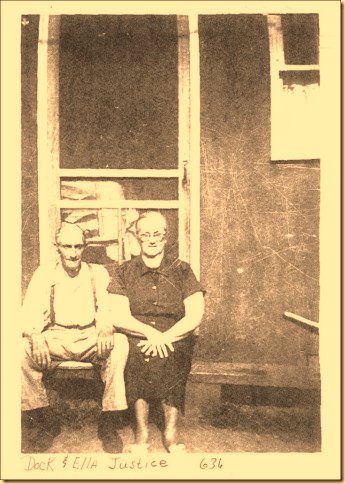
Uncle Dock Justice

This is Mom’s Uncle Dock and his wife Ella…
Click to view full size.

March 26, 2010

Aunt Fanny

Another old photo, this is Mom’s Aunt Fanny…

Fanny Sawyers photo Sawyers_Fanny.jpg


She was an older sister of Grandma Rachel.

March 25, 2010

Republic Steel Workers

Here is another of the old photos I found…


Click to view full size.
This is a gathering of men who worked for the Republic Steel Mine on Road Creek.  They are at the fish ponds on Elkhorn Creek.  Dad is easy to find, he is in the dark shirt, fourth from the right in the row of men standing.  Uncle Teet is in there too.  He is also standing, fourth from the left. 
I can recognize a coupe of the other men.  I’m pretty sure that is Vinton Thacker ( Roger, Butch and Tina’s dad ) standing on the left end.  Lee Robinson is kneeling in the front, right above the word ‘Workers’.
We need to get Dad to identify the rest of them for us.

Clyde


March 24, 2010

More Old Photos

While killing time at the Pikeville Public Library recently I came across a big collection of old photos on one of the computers there.  I copied several of them to share here.  I don’t think this first one needs any introduction…
Click to view full size.  
I’ll try to post more of them in a day or two.
Clyde

July 30, 2009

Old Photo: The Wards

I was looking through Russell Fork River Basin Area – Pictorial History with Mom a while back and we came across this old photograph:

CLICK to view larger.
Mom looked at it intently, pointed to the lady on the right and said excitedly, “Why that’s Ginny!  She was a midwife, she delivered me!”  The Wards lived near the mouth of Road Creek and Ginny apparently delivered many of the babies born there, including Mom.

The other woman in the photo, Melvina, was a relative of our Grandma Angeline.  I’m not sure if she was a half-sister or first cousin or maybe both.  (Get Mom to explain it to you.)

Clyde

May 7, 2009

Mommy’s Memories

When Luci was here in March she got Mom to talking about how things were when she and Dad first got married.  Here are a couple of memories that Mom shared;


When Mom and Dad first married, Uncle Miles and Aunt Ida lived across the river near where the old swinging bridge was. 

In the summer they would get in a small row boat and go visit them and fish a while on the way.  When Clyde was a baby they took him along.
Click on photo to view full size.


Once they went to church and left Clyde with Uncle Jennings and Maw’line.  Mom had put the little stoppers under the nipples of the bottles she left for him. Maw’line didn’t know about them. Clyde screamed for three hours while sucking on those bottles. 
That was the only time that Maw’line ever kept Clyde.

March 31, 2009

Anderson Adkins' Appeal

Like some others of  you perhaps, I have long been curious about Anderson Adkins and the shooting spree for which he was sentenced to Kentucky's electric chair.    The shootings and the execution all happened before I was born but I couldn't help but hear about them as I grew up.  Mrs. Bentley, who was blinded by one of Anderson's bullets, lived next door to our Aunt Virgie.   Anderson was an uncle of Aunt Avolene and a brother to Carrie Coleman, Aunt Hula's mother.  One of the victims, Clarence Blackburn, was a brother to James Blackburn who attended church with us at the mouth of Jimmies Creek. 
The following is information I came across recently at the library.  It seems Anderson was first tried for the murder of Verna Long and was sentenced to life in prison.  In a separate trial for the murder of Mrs. Jettie Johnson he received the death sentence. He appealed that conviction  to Kentucky's Court of Appeals.  This is the text of that courts ruling.  In between a lot of legal mumbo-jumbo is quite a bit of testimony about what happened the day of the shootings.


ADKINS v. COMMONWEALTH
301 Ky. 384, 191 S.W.2d 935
E. J. Picklesimer, of Pikeville, and John L. Harrington, of Paintsville, for appellant.
Eldon S. Dummit, Atty. Gen., and H. K. Spear, Asst. Atty. Gen., for appellee.
REES, Chief Justice.
Anderson Adkins has been convicted of the crime of murder, and his punishment fixed at death. The indictment charged him with the murder of Mrs. Jettie Johnson, wife of Tom Johnson of Pike county. The serious responsibility rests upon this court to determine whether or not prejudicial error was committed at appellant's trial in the lower court.
Anderson Adkins married Elmo Bentley, daughter of Mr. and Mrs. Fayette Bentley of Pike County, in 1933. He was then 21 years of age and she was 18. They have one child, a son, now 11 years of age. They lived in Pike county near Marrowbone in the neighborhood where their respective parents and the married brothers and sisters of Mrs. Adkins resided until 1942, when they moved to Baltimore, Maryland, where appellant obtained employment in a ship building plant. They returned to Pike county, Kentucky, in the late winter or early spring of 1944. In April, 1944, Mrs. Adkins filed suit for divorce and for the custody of the child, and while the divorce suit was pending went to Fairfield, Ohio, where she obtained employment in a defense plant. She left the child with her parents. Appellant went to Fairfield in July, 1944, for the purpose, as he claims, of effecting a reconciliation. He testified that a reconciliation was effected, but that three or four days later his wife received a letter from someone at home and thereafter refused to live with him. He returned to Pike county and went to his parents' home to live.
Later a divorce was granted to Mrs. Adkins and she was given custody of the child, but appellant was given permission, either by order of court or by his divorced wife and her parents, to see his son at least once a week. He went to the home of Mr. and Mrs. Fayette Bentley practically every Saturday afternoon, got the boy, and took him to various places, sometimes to the Adkins home, sometimes to Pikeville where they attended the theatre. He usually returned the child to the Bentley home on Sunday.
On February 10, 1945, he went to the Bentley home, but was refused permission to take the child with him. On the following day, about 2 o'clock in the afternoon, he appeared in an automobile at the filling station operated by Verna Long and her husband. Verna Long was the sister of his divorced wife. According to the testimony of appellant, he purchased and paid for five gallons of gasoline and then asked Verna Long to endeavor to obtain the consent of her sister, Elmo, to his having the custody of his son. She replied: ‘I will write her no letter and if I can do anything to prevent it you won't be seeing Jimmy or Elmo either again.’ Appellant testified that he remembered nothing from that moment until he was arrested on Hurricane mountain a few hours later.
The evidence for the Commonwealth shows that appellant did purchase gasoline at the Long filling station, and that Mrs. Long waited on him. While she was standing by the side of his car, apparently engaged in conversation with him, he suddenly drew a pistol and shot her. She ran toward the rear of the car, and he got out and continued to fire his pistol. In the meantime an automobile had driven up and stopped just behind appellant's car. Mr. and Mrs. Bryce Childers were in the front seat and their child, a small girl, was riding on the rear seat. One of the bullets fired at Mrs. Long passed through the windshield of the Childers car and struck the little girl.
Earl Johnson and his wife, riding in a truck, passed the filling station just as the shooting occurred, and saw appellant shoot at Mrs. Long. She fell on the paved part of the road, and appellant walked up to her body and struck her with the pistol. He reloaded his pistol, got in his car, and drove rapidly down the road to the home of Bill Goff about 1/2 mile away. He parked his car in front of the Goff home and walked to the house, which was located about 100 feet from the highway. He had his pistol in his hand. Mrs. Goff met him at the door and he asked for her husband, and was told that he had gone up the road, although Bill Goff at the time was in the house listening to the radio. Appellant said, ‘I hope I meet him; I will get him and I will get old Fayette,’ meaning Fayette Bentley, the father of his divorced wife. He told Mrs. Goff that he had killed Verna Long. There was proof that he had attempted to shoot Goff a few weeks before this transaction, and there was evidence from which the jury could reasonably infer that he was incensed at Goff because he believed that Goff had some part in the separation of himself and his wife. Goff was not related to the Bentley family.
Appellant got in his car and drove rapidly back toward the Long filling station, where the body of Mrs. Long was still lying in the road. As he approached the home of Mr. and Mrs. Tom Johnson, which was located almost directly across the road from the filling station and about 100 feet away, appellant suddenly applied his brakes. He was traveling at such a rapid rate of speed that the car swerved, went over an embankment, and stopped in the ditch. Mr. and Mrs. Johnson and their son-in-law, Ed Burgess, had heard the shots fired in the road in front of their home, and had walked to the front part of the yard to ascertain what had happened. They saw the body of Mrs. Long lying in the road, and Burgess walked out in the road and placed his handkerchief over Mrs. Long's face. When appellant's car stopped in the ditch Mr. and Mrs. Johnson started back toward the house, and Mr. Johnson went around the house. Appellant followed with the pistol in his hand and overtook Mrs. Johnson just as she reached the front steps. Burgess testified as follows as to what happened at this point:
‘Adkins came on up and when he got in about ten feet of Mrs. Johnson, Mrs. Johnson said ‘Anderson, I have never harmed you, what are you coming up here for?’ and Anderson Adkins said, ‘Oh yes, you have, I have come to get you,’ and immediately started firing; when he raised his pistol to fire Mrs. Johnson put her hands up to her face like this (indicating) and the first shot hit her right here (indicating).'

John Thacker, the only other eyewitness to the shooting of Mrs. Johnson, testified on direct examination as follows:
‘I came down to my brothers there and was up there and I heard the shooting, the shooting of Mrs. Long and I came down where Mrs. Long was lying on the road and I seen Mr. and Mrs. Johnson coming down the hill and seen that fellow over there (indicating) also coming down the hill; this other man came on down to where the woman was lying on the road and Mrs. Johnson looked down the road and seen Anderson Adkins coming up the road in a car then she took towards her house and Mr. Johnson and I took after her, and Anderson came on and wrecked his car and came on up the hill and headed her off before she got in the house and shot her. * * * He came out of the car with a gun in his hand. * * * Anderson Adkins got up to where she was and said damn you I am going to get even with you and he fired.’
On cross-examination he testified in part as follows:
Q. How far away were you when Anderson Adkins got up to where Mrs. Johnson was? A. I would say around ten feet; not over 20 feet.
‘Q. And you seen Anderson Adkins have the pistol in his hand? A. Yes sir.
‘Q. Did you say anything? A. Yes, I said don't do that Anderson.
‘Q. Do what? A. He was going towards her with the pistol in his hand and I thought he was going to kill her.
‘Q. Why did you think he was going to kill Mrs. Johnson? A. He was going towards her with the pistol in his hand but I didn't know who he was going to kill; I thought he was going to kill her.
'Q. And you told him not to do that? A. Yes I did.
'Q. What did Anderson say then? A. He didn't answer.
‘Q. Did he look at you? A. No sir.
‘Q. What did you do then? A. I went over the bank.
‘Q. Did you get over the bank before the pistol fired? A. No sir.
‘Q. How soon after you said Anderson don't do that until the pistol fired? A. Just immediately after I said that.
‘Q. How close was Anderson to Mr. Burgess and Mrs. Johnson then? A. I don't know exactly.
‘Q. About how far? A. Well when he began shooting he was right up close to her.
‘Q. How close were you to Anderson when you told Anderson not to do that? A. Maybe ten or twenty feet.
‘Q. And when the pistol fired he was right up close to her? A. Yes sir.
‘Q. How close? A. I don't know; maybe three or four feet.
‘Q. Did Mrs. Johnson have her hands up over her face at that time? A. She throwed her hands up to her face and was begging to him.
‘Q. What did she say? A. She said I have done nothing to you Anderson, don't kill me.’
On re-direct examination he was asked this question and made this answer:
‘Q. When Mrs. Johnson told the defendant not to kill her, that she had done nothing to him, did the defendant make any answer to that? A. He just said ‘damn you I am going to get even with you.’'
Three bullets struck Mrs. Johnson; one in the breast, one near the right eye, and one in the back. She died immediately.
On the day in question, Mr. A. E. Auxier, an attorney of Pikeville, Kentucky, was driving in an automobile with his wife from Pikeville to Elkhorn City, and reached the Long filling station just after the shooting of Mrs. Johnson. He saw the body of a woman lying in the road and drove his car onto the berm of the road and stopped. He observed a car in the ditch a short distance down the road, and saw appellant across the road from the ditched car loading his pistol. Appellant crossed the road diagonally to the Auxier car and said: ‘I have to have this car.’ Mr. and Mrs. Auxier got out of the car, appellant told them to stand back, got into the car and said, ‘I will do the driving,’ and drove off up the road.
He was next seen a few minutes later on Harless Creek about 2 1/2 miles from the Long filling station. An unimproved road parallels Harless Creek and connects with the main highway from Pikeville to Elkhorn City near the mouth of the creek. On this road a short distance from the main highway lived Mr. and Mrs. Fayette Bentley, parents of appellant's divorced wife, her brother, Burton Bentley, and his wife, and her sister, Mella Bentley Blackburn, and Clarence Blackburn, her husband. Appellant drove to Burton Bentley's home, but Burton was not at home. His wife and baby were in the house. Appellant rushed into the house with his pistol in his hand, and, when told that Burton was not at home, said: ‘I will let him do a little suffering, he is not here.’ Thereupon he shot Mrs. Bentley in the breast, and as she ran through the door into the next room where her baby was in a crib, he fired another bullet striking her in the arm. As she sank down on the floor appellant fired another bullet into her head, then kicked her three times and left. Mrs. Bentley recovered and testified at the trial of this case, but we infer from the record that she is totally blind from the effects of the last shot.
Appellant next went to the Blackburn home, parked his car, walked onto the porch, opened the door and walked into the dining room where Mella Blackburn and her husband were sitting at the dinner table. Mrs. Blackburn testified as follows:
‘We heard footsteps on the porch and the door flew open and Anderson Adkins came in with his hand in his right pocket, and he said ‘I have come after you and your mother both, what have you to say?’ and he walked around and put his pistol to my back and my husband knocked the gun down and he shot my husband once through the heart and he raised the gun at him again and my husband said ‘Anderson don't do that, you have shot me through,’ and he shot him again in the same place and I jumped in between them and we wrestled around and finally my husband got the gun-it was a .38 pistol and my husband got hold of the pistol and he run to the front door and as he threw the gun into the creek he fell.'
A little further along she said:
‘While we were wrestling around Anderson had me down a time or two and I got loose, I don't know how, but I got loose and my husband was calling to me and I started out on the porch to my husband and Anderson knocked us both off the porch and came on down on me and I got loose and got him down, and Anderson said ‘I have got four forever, but I have one that is innocent,’ and then he asked me to let him up; I let him up and I turned and looked at my husband who was hollering for me to come to him, and Anderson said ‘By God I have got four forever’; so he went on out through the gate and over to his car and was looking around in his car and I began hollering for help and Anderson went around the car and was looking in the creek for the gun, and as he came back to his car my mother-in-law was with me; after he was at the creek looking for his gun he said ‘By God I will come back after you and your mother,’ and hopped into the car and left.'
Clarence Blackburn died within thirty minutes after he was shot. Mrs. Blackburn found appellant's pistol in Harless creek in front of her home a few minutes after appellant left. Counsel for appellant state in their brief that appellant went first to the Blackburn home and then to Burton Bentley's home, but, although the record is not clear on this point, a fair inference is that he went first to the Bentley home and then to the home of Clarence Blackburn.
Before he reached the main highway, about 1/4 mile below the Bentley home, appellant overtook a truck which had stalled and blocked the road. The truck belonged to Shannon Sawyers, who testified:
‘I was up at the house about 150 yards I guess from where the boys had the road blocked and Anderson came down the creek he was driving pretty fast, and I went down to see what the trouble was that they couldn't let him by; Anderson was standing near the back of the truck that wouldn't run and he said ‘for mercy's sake, unblock me, I am in a hurry, I want to get by,’ and then he said ‘they will follow me.’ We pushed the truck out of the road so he could get by and Anderson helped us push the truck out of the road.'
Appellant drove to the main highway and back down that highway past the Long filling station and on to the Lavisa fork of the Big Sandy river, about 8 miles beyond the filling station, where he ran the Auxier car into a ditch and abandoned it. He passed the filling station about 30 minutes after the shooting of Mrs. Johnson. A truck occupied by Scott Blackburn and Mrs. Blackburn overtook appellant, and he asked Blackburn to take him to the store operated by Hayes Justice which was located at the foot of the mountain about 400 yards up the road. Hayes Justice is appellant's cousin. While in the truck he told the Blackburns that he had killed four people, Orbin Long's wife, a Johnson woman, a Blackburn, and a Bentley. Appellant got out of the truck and went in the store where he had a short conversation with his cousin, Hayes Justice. He left the store and started up the mountain toward the Virginia state line. Two highway patrolmen, Tony Robinette and T. S. Saulisbury, arrived a few minutes later and started in pursuit of appellant. They overtook him about three miles from the store. He started to run, but Robinette fired several shots from his pistol and appellant surrendered to the officers. Robinette was asked this question and made this answer:
'Q. Did the defendant say anything when he came back to you? A. Yes, he asked us to shoot him and leave him in the mountains, and said he had killed four or five people and maybe that would be a lesson to them to keep their damn bills out of his business.’
On this point, Saulisbury testified as follows:
‘He told us about the trouble he was in that he had killed some four people and he would rather we would just shoot him and leave him up there, and then coming off the hill we asked him if he realized what he had done and he said yes he had killed four people and that would be a lesson to them to keep their bills out of his business.’


Appellant seeks a reversal of the judgment on three grounds:
(1) His motion for a continuance should have been sustained;
(2) the court erred in having a jury summoned from an adjoining county; and
(3) incompetent evidence which was highly prejudicial to his rights was admitted over his objections.
The first ground is wholly without merit, and is not seriously pressed. The indictment was returned February 15, 1945, and on that day appellant entered a plea of not guilty and the case was set for trial on February 28, 1945. When the case was called for trial, appellant announced that he was not ready and moved for a continuance, and, in support of his motion, filed his own affidavit and the affidavit of his attorney, E. J. Picklesimer. The motion was sustained, and the case was continued to the March term of court and set for trial on March 22, 1945. It seems that the Commonwealth elected to try the appellant upon the indictment charging him with the murder of Verna Long. He was convicted and sentenced to life imprisonment. On March 28, 1945, the case in which he was charged with the murder of Mrs. Jettie Johnson was continued to the May term and set for trial on May 21, 1945. On May 14, 1945, an order was entered directing the warden of the penitentiary at LaGrange, Kentucky, to produce the appellant forthwith to the jailer of Pike county, but he was not taken to Pikeville until May 21st, the day his case was set for trial. A motion for a continuance was filed, and in an affidavit in support of the motion it was stated that appellant had had no opportunity since his trial in March for the murder of Verna Long to consult with his counsel or his friends; that John L. Harrington, one of his employed attorneys, was absent; that he had ordered and paid for a transcript of the evidence heard at his trial for the murder of Verna Long, but had not received the transcript until May 21st and his attorneys had not had an opportunity to examine it. Mr. E. J. Picklesimer, who represented him at the March trial was present. The court overruled the motion and proceeded to the selection of a jury. When court adjourned for the day all members of the panel had been excused for cause except three, and all of these were peremptorily challenged the following day, two by appellant and one by the Commonwealth. The court entered an order directing the sheriff to summon a special panel of jurors from Letcher county, and court was adjourned to the following day. On May 22nd both of appellant's attorneys were present and a jury was selected from the special panel. No evidence was introduced until May 23rd. Appellant was not prejudiced by the absence of one of his attorneys on the first day of the trial, as he was represented by one competent attorney who was thoroughly familiar with the case and the only step taken in the absence of the other attorney was the examination of the jurors on the regular panel, and all of them except three were disqualified for various reasons and the three who were qualified were still on the tentative jury when both attorneys were present. The attorneys had represented appellant at the March trial and were familiar with the facts. They had ample time to examine the transcript of the evidence heard at the trial although it was not delivered until May 21st. The court did not err in overruling the motion for a continuance.
Likewise, it was not error to summon a jury from an adjoining county. The trial judge made a fair effort in good faith to satisfy himself that it would be impracticable to obtain a jury free from bias in Pike county. The appellant had been tried at the March term of court on an indictment charging him with a murder growing out of the same difficulty, and that trial had been given wide publicity in the newspapers circulating in Pike county. Out of the regular panel only three were found upon their examinations to be qualified for jury service in the case. Later these three were peremptorily challenged. Under these circumstances, the summoning of a jury from another county was not an abuse of discretion. Furthermore, it appears from the order that it was made by the court after a conference with the attorneys for both sides and without objection being offered thereto.
It is next insisted that all of the evidence concerning the transactions which occurred prior to and subsequent to the shooting of Mrs. Johnson was incompetent and prejudicial to appellant's substantial rights, and it is argued that the evidence should have been confined to the testimony of the eyewitnesses to that shooting. The general rule is that in a criminal prosecution proof which shows or tends to show that the accused is guilty of the commission of other crimes and offenses at other times is incompetent and inadmissible for the purpose of showing the commission of the particular crime charged, but there are exceptions to this rule which are as well established as the rule itself. For instance, proof of other crimes is competent to establish identity, guilty knowledge, motive, plan, state of mind or intent.  This is particularly so where the accused relies on a lack of intent or a want of guilty knowledge. In the instant case, a showing of guilty knowledge, motive or intent, especially when appellant's defense is considered, is wholly absent if the evidence is confined to the bare facts of the killing of Mrs. Johnson. Appellant defended on the ground that he did not intend to kill Mrs. Johnson, the killing was without malice and he had no knowledge of the transaction. All of the offenses concerning which proof was admitted, including the shooting of Mrs. Johnson, occurred within a short period of time, approximately 30 minutes, and constituted one continuous transaction. It is obvious from the evidence that appellant was actuated by the same motive and had the same purpose throughout; that is, to wreak vengeance on those who, in his opinion, had interfered in his marital difficulties. This motive, his intent, state of mind and knowledge could be established only by showing what he said and did shortly before and after the crime was committed. The following from the text of 20 Am.Jur., Evidence, section 313, is pertinent in the light of the facts of the present case:
‘Whenever mental state, guilty knowledge, or scienter is an essential element of the offense charged, evidence is admissible of acts committed by the accused and his conduct at or about the time of the commission of the offense charged against him which tend to establish his knowledge or intent, his motive for the commission of the crime, the absence of mistake or accident or of a common scheme, plan, or system on his part notwithstanding such evidence proves or tends to prove an offense other than that charged. In short, evidence of other crimes is admissible to prove malice or malicious intent with regard to the offense charged.’
The evidence shows that appellant had made threats against members of the Bentley family and others who, as he believed, had sympathized with and assisted his divorced wife. There is no evidence that he made specific threats against Mrs. Johnson, but on one or two occasions Mrs. Anderson and her sister, Verna Long, went to the Johnson home immediately after difficulties with appellant. He was at his home a short distance away, and the Johnson home was in plain view. His statements when he shot Mrs. Johnson, coupled with his acts and statements at the scenes of the other offenses, indicate that he was influenced by the same motive in all of his acts on the occasion in question. Moreover, these statements and the statements made by him immediately after his arrest show that he realized the nature of his acts. When objections were made to the evidence of other crimes, the court properly admonished the jury as to the purpose for which it was admitted and how it was to be considered by them. A careful examination of the record convinces us that the court protected appellant's rights fully in the admission of evidence.
The severest punishment known to the law has been meted out to the accused, but he committed a heinous crime, and there are no mitigating circumstances justifying a lesser penalty.
The judgment is affirmed.
Ky.,1946
ADKINS v. COMMONWEALTH
301 Ky. 384, 191 S.W.2d 935
END OF DOCUMENT

March 18, 2009

Looney Family Traits

I've ran across these Looney Family Traits on a couple of different websites. Thought you might enjoy them...


Militant......A Looney will fight; they have been in every war from Marlboro in Flanders (1689) to Korea. They feud and fight among themselves when there are no wars.
Clannish......Like English Royalty - they marry among themselves; cousins marry cousins; brothers marry girls who are sisters, until whole neighborhoods and school districts become populated by relatives of relatives.
Snobbish......Looneys who have money never claim kin with poor relations.
Stingy......"A Looney will skin a gnat for its hide and tallow."
Contrary......"A Looney will run through a briar patch rather than walk around it, then cuss it for being there."

These sound pretty accurate to me. I think I saw a mason jar about half full of gnat tallow the last time I was in Mom and Dad's basement. I don't know what she does with the hides after she gets them tanned and dried.

November 11, 2008

John Looney Clipping

This one doesn't need any explanation.  I thought some of you might want a copy for your files.

November 6, 2008

Baker Genealogy

The Baker's are another branch of Jim Schell's family tree.  The following is an article from the March 2007 Issue of The Kentucky Explorer.  I have added some photos, some links to Wikipedia articles and shown Jim's direct ancestors in bold print. 

The Bakers of Leslie County, Kentucky, have an interesting and varied history in the United States of America. The following information has been gleaned from history, official documents, interviews, and even some from the Internet like ancestry.com. Once again, as in the article I did on the Joseph's of Leslie County, I must credit my wife, Pauline, who has spent too many hours to count in her research. I used her research plus mine, along with personal interviews to complete this article. I don't guarantee this is 100 percent accurate because memories fail, some individuals have axes to grind, and census takers have very poor penmanship. However, any information that is suspect has been excluded or explained in the article. If you find something you feel is suspect, I urge you to check it out yourself.

The story begins in Kent, England, in 1422 with the birth of John Baker. He later married Mary Hyde and had a son, Simon.
Simon Baker, born 1442 in Feversham, England, married Mary Broom and had a son, Jacob.
Jacob Baker, born 1475 married Abigail Baker and had a son, John, in 1496.
John Baker married Elizabeth Dinley and settled in Trentenden, Kent, England.
Their son, Christopher Baker, born in 1515 later married Dorythe Thomsone and had a son, George.
George Baker, born 1557 married Anna Swaine and had a son, Alexander Thomas Baker.
Alexander Thomas Baker, born in 1573 married Frances Briggs Pendleton, widow of Francis Pendleton and had seven children. They were: John, born 1600; Alexander Nathaniel, born 1607; Henry, born 1610; Alice, born 1611; Mary, born 1612; Ann, born 1613; and Winneford, born 1614. Upon Frances' death he married Alice Jervis but had no offspring with her.

Alexander Nathaniel Baker was born near London, England, in 1607. He married his wife, Elizabeth Ann Farrar or Flourney, in 1631, and during their marriage had 12 children. Elizabeth was born in London in 1632, and Christine was born in 1634. The remainder were born in America.
At some point in time, before leaving England, Alexander went into the cordage business and was quite successful. Cordage is rope and there was great need for it in the days of sail. Sails are attached to masts, spars, and braces by ropes, and then the masts themselves have to be held up by more ropes. A schooner or barque, considered small ships of the day, used thousands of feet of rope, and rope was always breaking and needing repaired or replaced. No ship would leave the harbor without a large supply of rope or cordage.
Edward Winslow Alexander and his family departed England in 1635 on their own ship, the Elizabeth Ann (also known as The Elizabeth and the Lizzy Ann in documents). Besides his family, he brought Clemon Chapman and William Swayna, two of his employees at his Cordage Manufacturing Factory. His ship also held his equipment to set up his cordage business, and furniture for his friend, Kenelm Winslow, brother to Edward Winslow who had come over on the Mayflower. Kenelm had come to Massachusetts a few years earlier, and he will play a prominent part in the Baker history later on.
The Elizabeth Ann landed at Plymouth Colony, located just south of what is now Boston. He was greeted by William Bradford, a friend as well as governor of Plymouth Colony; however, they soon parted company due to irreconcilable religious differences. Baker was a Baptist and Bradford was more a Calvinist. Baker moved north to the Boston area and set up his cordage business and lived in that vicinity for the remainder of his life.
He sired ten more children with his wife, Elizabeth. They were: Alexander, born January 15, 1635; Samuel, born January 16, 1638; John, born June 20, 1640; Joshua, born April 30,1642; Hannah, born July 29, 1644; William, born May 15, 1647; Joseph, born April 8,1649; Sara, born May25,1651;Benjamin,born July 30, 1652; and Josiah, born February 26, 1654.
Alexander was quite successful and well-thought-of in the community He served as Clerk of the Market from March 1666 to March 1667. In 1674 he was discharged from taking further training with the militia because he owned his own weapons. He was made a constable in April 1676, and at that point in history few ordinary citizens served in offices of trust. Rather, those were restricted to men of property like Alexander. He and his family were accepted into the Boston Church on October 4, 1645, and all his children were baptized. It is not known if he sold his cordage business or branched out into making collars, but he is listed as a collar maker upon his death. These collars were probably leather collars for draft animals.
Alexander died between February 18, 1684 (the date of his last will), and May 1, 1685, (when the will was probated). He left seven surviving children. They were: John, Joshua, William, Josiah, Elizabeth Baker Watkins, Christina Baker Roberts, and Sarah Baker Wales. He left all of those five shillings, except William to whom he left the business because William had worked with him and learned the trade.

Samuel is the next progenitor of the Leslie County Bakers. I feel there is some controversy here. The records of the Boston Church shows a Samuel Baker dying at age seven, and he is not listed as one of the Alexander's heirs in the will.  He could have predeceased his father. He could also have been disinherited. Samuel would have been 46 at his father's death. Additionally, there are in excess of 100 items quoting dozens of sources that place this Samuel as the son of Alexander Baker. Readers will have to choose, but remember; the Samuel written about in this article lived in Boston in the 1600s and is the progenitor of the Bakers in Eastern Kentucky.

Samuel Baker was born January 16, 1638, in Boston. He married Eleanor Winslow in Marshfield, Plymouth County, Massachusetts, on December 29, 1656. She was the daughter of Kenelm Winslow. Samuel and Eleanor had ten children by their marriage. They were: Kenelm, born 1657; Lydia, born 1659; Elizabeth, born 1661; Alice and Eleanor, twins, born 1663; Mary, born 1667; Ellen, born 1669; Alexander, born 1671; Thomas, born 1673, and William, born 1675. Eleanor died on August 27, 1676, at the age of 39.
The following year on February 21, 1677, Samuel married Patricia Barstow Simmons. They had four children by their marriage: Eleanor, born 1679; the earlier child must have died; Samuel, born 1680; Josiah, born 1682; and Thomas, born 1684. Samuel died in 1714 and is buried in Marshfield Cemetery located outside of Boston.
An added footnote concerns the Winslow's. Eleanor's Uncle Edward came over on the Mayflower and became governor of the colony. The Winslow House still stands in Boston. Eleanor's father, Kenelm, came to the colony in 1633. It was his furniture that Alexander Baker transported to America on the Elizabeth Ann. Their children later married.

William Baker, Sr., born in 1675 is the next in the line of the Leslie County Bakers. He married Mary Corbie, born November 13, 1691, in East Haddam, Connecticut, November 13, 1710. At some point after their marriage they moved to Chester, Pennsylvania, where their children were born. They were: Thomas, born January 8, 1711; William Jr.; Hannah; Josiah; Mary; and Frances. At some point in time he moved to Orange County, Virginia, and some sources say he served in the Virginia House of Burgesses. He died in 1748.

Thomas Baker, grew up in Virginia and met and married Dorothy Davenport of Hanover County, Virginia, 1734. She was born November 2, 1716, and was the daughter of Martin and Dorothy Glover Davenport. Note: Naming a daughter after the mother must have been a custom of the Davenport family as will be seen later. Their marriage produced 13 children. They were: William, born 1735; Thomas II, born 1737; Mary, born 1739; Martin, born 1741; Cortia, born 1743;-Josiah, born 1745; Henry, born 1747; David, born 1749; Dorothy, born 1751; Richard, born 1753; James, born 1755; John, born May4, 1758; and Charles, born 1762.
Thomas and his wife lived in both Virginia and North Carolina or at least had a North Carolina connection. Yet when the Revolutionary War started he was in Virginia. He and his sons were active in the Revolutionary War. Although Thomas didn't serve, he made gunpowder for the Army. At least three of his sons' actively served. Captain Richard Baker, Captain John Baker, and Corporal David Baker crossed the Delaware with General Washington to fight the Hessians at the Battle of Trenton. There were many casualties on both sides, one of which was Captain Richard Baker. He had been killed on December 26, 1776. The remaining two survived the war, but Thomas didn't. His gunpowder factory exploded, and he died in Culpepper, Virginia, on January 10, 1777, just two weeks after Richard's death. He probably hadn't received word yet which was a blessing.

Soon after Thomas' death, his wife, Dorothy, along with her sons, James, Charles, and John, moved to Morgantown, North Carolina. It is John Baker who is next in line for the Leslie County Bakers. He met his future wife there, and shortly thereafter married Elizabeth Ann Norfleet, who was the daughter of John and Elizabeth Reddick Norfleet of Chowan County, North Carolina.
John and Elizabeth Ann (called Nancy) were married around 1777. Their children were John, Jr.; Thomas; Isaac; Nancy; William; Ann; Lucinda; Robert; James; Wilson; and Joseph. John was a captain in the 77th North Carolina Regiment joining on November 28, 1776. As stated previously he was with Washington on Christmas Day when they crossed the Delaware. In the North Carolina list of Revolutionary soldiers, it shows that he was granted a patent on 1,462 acres of land because he served 32 months. In 1811 he took his family to Kentucky and ended up in the Cutshin area in what is now Leslie County.

John Baker, Jr. was born around 1777 in New River, Ashe County, North Carolina. He married twice and had a large family. His first wife was Sarah Alpha, born in 1778. His second wife was Chloe McIntosh, daughter of Roderick McIntosh and sister of Rory. She was born in the Scottish Highlands in 1773 and came to America with her family in 1782. They had ten children. She and John, Jr., moved to Bakersville, North Carolina, in the early 1800s.
About 1809 or 1810 John, Jr.; his son, Wilson; and Roderick "Rory" McIntosh traveled on packhorses to Kentucky looking for places to settle. Rory staked out a piece of property in what would later be known as McIntosh Creek in then Perry County, but later Leslie County. They returned to North Carolina to report to their respective families. The following year the Baker family, the McIntosh family, and several others sold their land in North Carolina, bought supplies, and left for Kentucky. Their livestock lived off the wild grass, clover, and pea vine found along the trail. The families lived on game, and the supplies they carried with them.
The group reached the North Fork of the Kentucky River in 1811. They hurriedly made camp and that night John, Jr., and Chloe's son, Isaac, was born. The families had planned to go farther, but fever and sickness struck many, and they decided to stay as a group until all were able to travel. They cleared four acres near present-day Hazard, planted crops, and built temporary shelters. It took two years for all to get well. By that time some families decided to stay in that area, but most of the Bakers and McIntosh’s moved on. One of the Baker boys was said to have built a cabin in what is now Hazard, and it became the first boardinghouse there. Later, the Hurst Hotel was built on that spot.
Some settled in Cutshin and on McIntosh Creek. John, Jr., and Chloe settled on First Creek in Perry County, but later moved to Cutshin. Besides Isaac, and not necessarily in the order of birth, they had Wilson, John Jackson, Rebecca, Elizabeth (Betsy), Nancy, Mary Polly, Jane (Jenny), Rachel, and Sarah “Sally." John Jr. was murdered at age 66 in an unusual manner. On the night of March 8, 1843, white sleeping alongside the riverbank, two of his slaves chopped off his head with an axe. The two slaves were hanged at Cutshin. John, Jr., is buried in Leslie County.


John Jackson Baker, born in Burke County, North Carolina, June 13, 1792, met and married Mary "Polly" Campbell. She was born at Wallens Creek, Ashe County, North Carolina, in 1795. She was the daughter of John Campbell and Mary Polly Couch. They married in Clay County, Kentucky, February 22 1816, and had nine children. They were Elizabeth and Virginia, born 1818; Nancy, born 1820; Christopher, born 1821; Sarah "Sally," born 1824; Wilson, born 1825; John Jackson, Jr., born 1826; Larkin, born 1827; and Henderson born 1828. (NOTE; Wilson Baker's daughter Nancy, born 1857 married Nick Schell.  This is where the connection to Jim's family name is made.)
After a divorce John Jackson married Rachel Fields on May 8, 1833, in Perry County. Rachel, born in 1808 in Clairborne, Tennessee, was the daughter of John Fields and Eliza Bailey. John and Rachel had ten children together. They were William, born 1831; Polly, born 1834; James, born 1936; Abby, born 1838; Lucinda, born 1841; Rachel and Tabitha "Berth," born 1845; Rebecca, born 1847; Nancy, born 1849; and Russell, born 1854. John died June 1887 on Cutshin Creek, Leslie County, Kentucky, at the age of 95.

It is from the offspring of John, Jr's children that many of the Bakers of Leslie and Perry Counties have sprung. To aid The Kentucky Explorer's readers, the following is furnished:
Isaac married Elizabeth (Eliza Jane) Griffith; Wilson married Polly Combs, then Sarah Sally Fields; John Jackson married Mary Polly Campbell, then Rachel Fields; Rebecca married Adam Campbell, then Elijah Campbell; Elizabeth married William Campbell; Nancy married Roderick McIntosh; Mary Polly married Isaac Campbell, then Roe Campbell; Jane married Henry Feltner; Rachel married James Testical Campbell; and Sarah (Sally) married William Begley.
One interesting note: Mary Polly married Chloe McIntosh's brother, Roderick "Rory" McIntosh, who was 21 years older than she, and she had four more children by him. They were: Susan, Margaret, Peggy, James, and Mary Polly. That makes the children of both marriages half-brothers and sisters. It gives them common great aunts and uncles as well as grandparents.
This takes the Baker line far enough forward to allow anyone interested to research their particular line. The Perry County Library at Hazard has an extensive section on the early settlers of both Perry and Leslie Counties. I encourage anyone interested to include this facility in their research endeavors because my wife, Pauline, had done considerable research into my family tree.

John Jackson Baker, Jr., son of John Jackson continues the Baker line.  He was born February 18, 1826, in Perry County, Kentucky. He married Sarah Maggard, born February 10, 1835, who was the daughter of John Benjamin Maggard and Sarah Maggard. They married about 1854. Their children were William, born 1854; Henry, born 1856; Sarah, born 1860; Polly, born 1862; Nancy, born 1864; and Rebecca, born 1866.
William Baker, a farmer on Wooton's Creek, was married three times. His first wife was Mary Polly Cornett. She was the daughter of Archibald Cornett and Juda Isaac. Wilson and John Jackson Baker continue the Baker line. Isaac married Eliza Jane or Elizabeth Griffith in 1828. Children by that marriage were John, David, Manerva, William, Cyhthia, Martha, Henry, and Maggie. Wilson married Polly Combs, but research has failed to show any children from that marriage. He then married Eliza Jane Fields and together they had Mary, Jackson William, Polly, Roderick, Jane, John, Rachel, and Robert.
David R. Caudill
3382 Clover Road
Bethel, OH 46103

November 3, 2008

The Giant of the Mountains

Michelle gave me some information a few days ago about Jim's family tree.  I have been looking to see if I could find anything to add to it.  So far, I have found more information on the CHURCH branch of his tree than any of the other lines.


There appears to be at least one very interesting character in his ancestry.  I have found several Internet pages that mention Jim's G-G-G-G-Grandfather Gabriel Church.  Here are a few excerpts...


From An Economic and Social Survey of Wise County, Virginia By Ralph Emerson Kennedy
The first settler on Powells River was Gabriel Church, known as the Giant of the Mountains. He settled on Roaring Fork, and it is told how he would shoot a deer, tie its legs together and hunt all day with it swung around him.


I imagine Gabriel probably looked something like this  drawing of an anonymous Mountain Man:

Gabriel was said to be a fine poet and balladeer. At least one song that he wrote has been preserved.  A few verses of his song "Poor Goins" are listed in these books:

The full lyrics of "Poor Goins", as well as an audio recording of the song done by a couple of  Gabriel's great-nephews, can be found at the Blue Ridge Institute & Museum website.  NOTE: You will need the Real Player plugin to be able to listen to the song.

October 7, 2008

Trick Photography

Michelle sent me this photo of the Schell Family recently.  It is supposed to be from 50 years or more ago.  What I can't figure out is...how did Justin get right there in the middle of the photo?

Click on the photo to view a larger version.

Michelle will have to let us know who everyone is in the picture.

September 22, 2008

Family Resemblance

In a previous post I mentioned Randy Ratliff's ancestor, Winright Adkins 1837 and how he was related to Jennie's ancestor, another Winright Adkins 1825.  The following is information on the family of Randy's ancestor:


Winright ADKINS was born 1837  in Pike County, Kentucky, and died 1918.  He was buried in Winright Adkins Cemetery, Pike Co, Kentucky. He was the son of Winston ADKINS and Hannah COLEMAN.
Louisa EPLING was born 10 JAN 1845 in Pike County, Kentucky, and died 1 FEB 1927  in Pike County, Kentucky. She was buried in Winright Adkins Cemetery, Pike Co, Kentucky. She was the daughter of Zebekiah EPLING.
Children of Louisa EPLING and Winright ADKINS are:   
  1. Perry ADKINS. He married Mero ABSHIRE. 
  2. Tom ADKINS. He married Lillie BARTLEY. 
  3. Floy ADKINS. He married Laura BARTLEY. 
  4. John H. ADKINS. He married Libbie COLEMAN. 
  5. Jim ADKINS. He married Bessie THORNSBURY. (Randy Ratliff's Great Grandparents) 
  6. Alcie ADKINS. She married David COX, son of John COX and Amanda Judy ADKINS. He was born 1863 in Pike County, Kentucky. 
  7. Clarinda Addie ADKINS was born 1871 in Pike County, Kentucky, and died 14 DEC 1897 in Pike County, Kentucky. She married William Drayton KENDRICK 10 DEC 1891 in Pike Co, Ky, son of Joseph Browning KENDRICK and Charity HART. He was born 5 DEC 1865 in Russell Co, Virginia, and died 4 AUG 1945 in Greasy Creek, Pike Co, KY. 
  8. Laura ADKINS died 1910 in Pike County, Kentucky. She married McCelland JUSTICE. 
  9. Ida ADKINS. She married Ol COLEMAN 21 APR 1898 in Pike Co, KY. He was born 7 OCT 1876  in Pike County, Kentucky, and died 14 JUL 1955 in Pike County, Kentucky. 
  10. Hannah ADKINS. She married Andy LONG. 
  11. Dulcie ADKINS. She married Crit MAY. He was born 3 MAY 1886, and died 9 JAN 1968.
  12. Meshac ADKINS.

While searching around the Internet for more information on this family, I ran across a page with Dulcie Adkins and Crit May's Family Photos. Dulcie was the younger sister of Jim Adkins and would have been Randy's Great Aunt.  Here are a few of the photos from that web-page:
This is Dulcie at age eight.  Does she remind you of any of the guinea girls or guinea grandkids?


Here is Dulcie four years later.  Any resemblance now to anyone you know?


One more before we quit.  This is a gathering of Crit May's family in 1930.  Does the young lady in the upper left look like anyone you know?